Hong Kong Cha Chaan Teng: Beginner Guide & Secret Slang
If you are planning a trip to Hong Kong—or have just stepped off the plane—you are likely researching the best local food experiences. In your search, you will undoubtedly encounter three words that form the absolute backbone of Hong Kong’s culinary identity: Cha Chaan Teng (茶餐廳).
Translating literally to “tea restaurant,” a Cha Chaan Teng is much more than a diner. It is a fast-paced, highly efficient, and incredibly affordable cultural institution where East meets West on a single plate. For newcomers, however, the massive menus, lightning-fast waiters, and crowded booths can feel overwhelming.
In this comprehensive guide, we will explore exactly what a Cha Chaan Teng is, the historic dishes you must try, and—once you are ready to level up—the secret ordering slang that locals use to navigate these bustling eateries.
What Is a Cha Chaan Teng?
To truly appreciate a Cha Chaan Teng, you need to understand its roots. Following World War II, Western cuisine in Hong Kong was largely restricted to high-end restaurants catering to British expatriates and the wealthy elite. The local working class desired these Western flavors but needed them at an accessible price point.
Enter the Bing Sutt (ice rooms), the predecessors to the modern Cha Chaan Teng. These cafes began serving “Canto-Western” fusion—local adaptations of Western meals using affordable, shelf-stable ingredients like canned meats, instant noodles, condensed milk, and white bread.
Today, the Cha Chaan Teng is a cornerstone of Hong Kong culture. It is an egalitarian space where construction workers, bankers, students, and tourists sit shoulder-to-shoulder to enjoy quick, comforting meals.
The Must-Try Menu: Iconic Canto-Western Dishes
Before mastering how to order, you need to know what to order. While menus can span hundreds of items, these core staples define the classic Cha Chaan Teng experience:
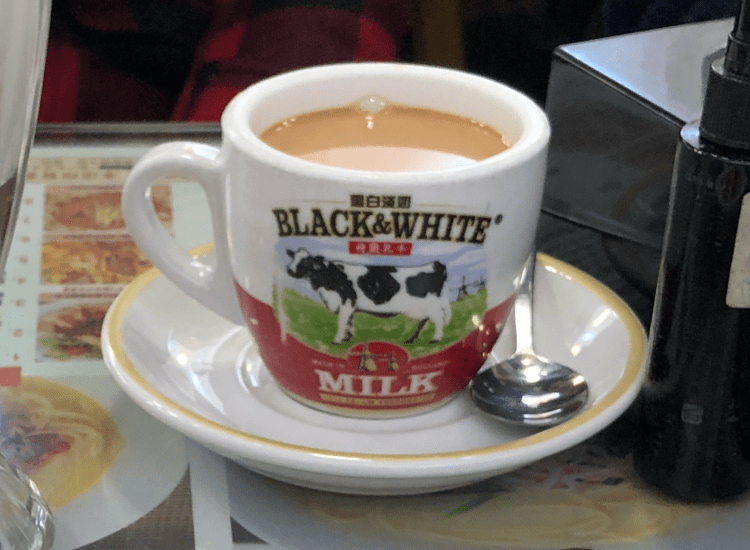
- Hong Kong-Style Milk Tea (港式奶茶): The undisputed star. A robust blend of black teas, typically brewed through a sackcloth bag (giving it the nickname “pantyhose tea”), mixed with rich evaporated milk.
- Pineapple Bun with Butter (菠蘿油): A fluffy, sweet bun topped with a sugary, crumbly crust that resembles a pineapple’s exterior (there is no actual pineapple inside). It is served warm with a thick, cold slab of butter stuffed in the middle.
- Hong Kong-Style French Toast (西多士): A decadent afternoon tea treat. Two slices of bread smeared with peanut butter, dipped in egg wash, deep-fried to a golden brown, and topped with butter and golden syrup.
- Yuen Yeung (鴛鴦): A uniquely Hong Kong beverage that combines three parts coffee with seven parts milk tea, creating a smooth, highly caffeinated drink perfect for a midday boost.
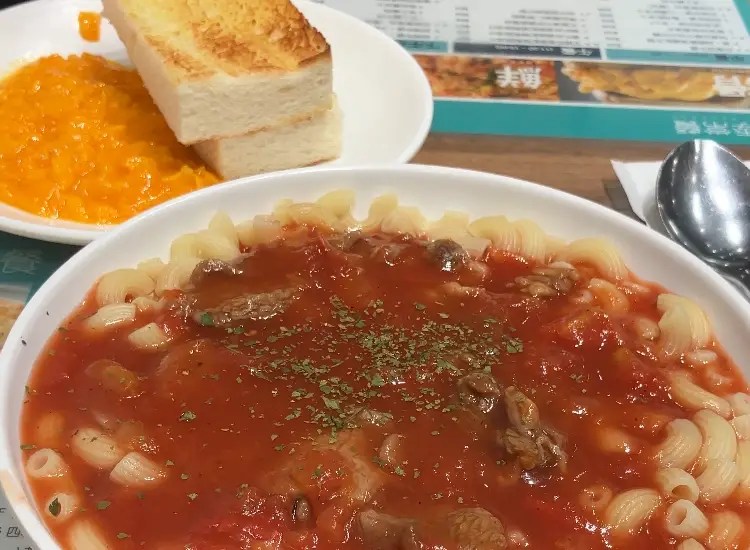
- Macaroni Soup with Ham (火腿通粉): A popular breakfast dish featuring elbow macaroni in a light chicken broth, topped with strips of processed ham. It is the ultimate local comfort food.
Secret Syntaxes in Your Daily Order
In a Cha Chaan Teng, efficiency is everything. Waiters are notoriously fast, and lingering over a menu is frowned upon. To keep up with the pace, Hong Kongers have developed a highly efficient, shorthand Cantonese slang to customize their orders. Learning a few of these “secret syntaxes” will not only get you a perfectly tailored drink but also earn you a nod of respect from the staff.
1. Controlling Your Ice and Sugar
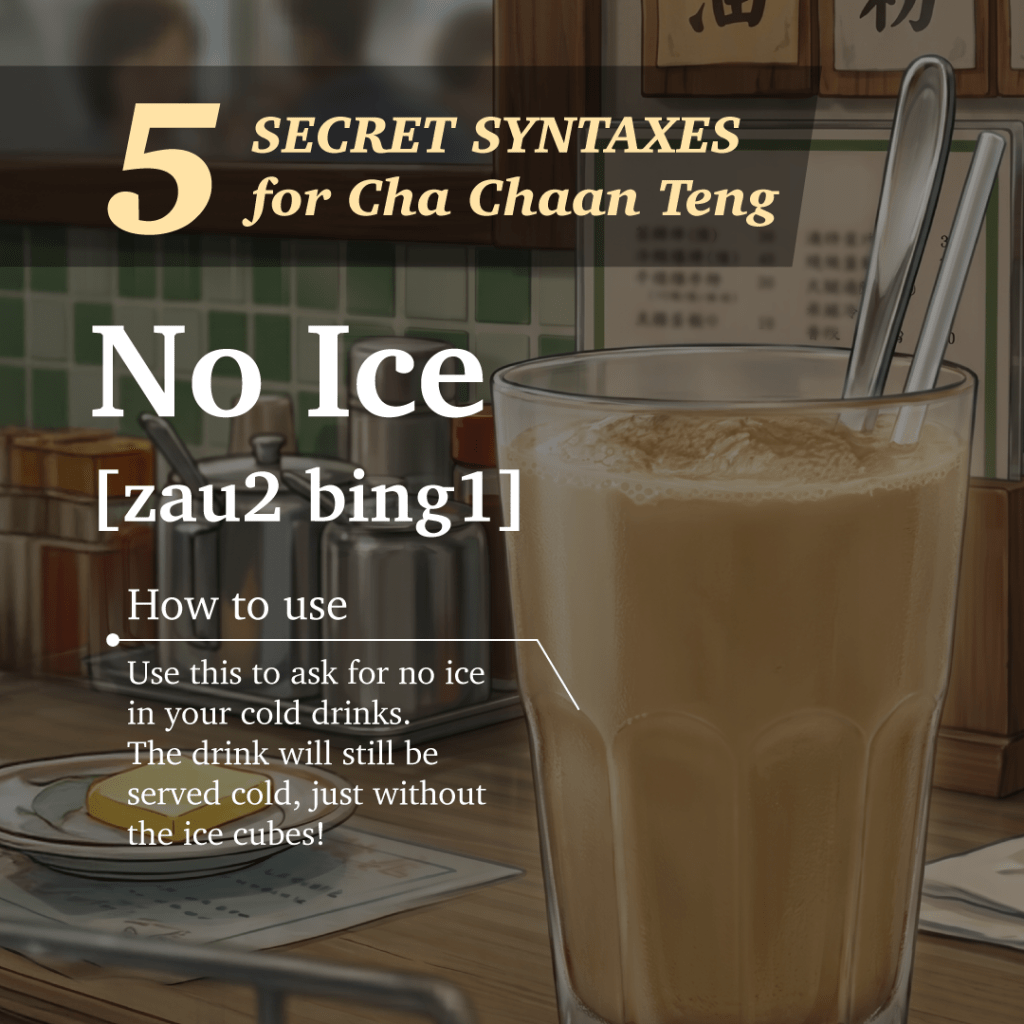
Most cold drinks are served pre-sweetened and packed with ice. Use these basic modifiers to adjust your beverage:
- No sugar [走甜 – zau2 tim4]: Removes pre-added syrup from your drinks entirely. For instant drinks like Ovaltine or Milo, it means no extra sugar is added.
- No ice [走冰 – zau2 bing1]: Use this to ask for no ice in your cold drinks. The drink will still be served cold from the fridge, just without the ice cubes watering it down.
- Less Ice [少冰 – siu2 bing1]: When ordering cold drinks, use this syntax to ask for less ice.
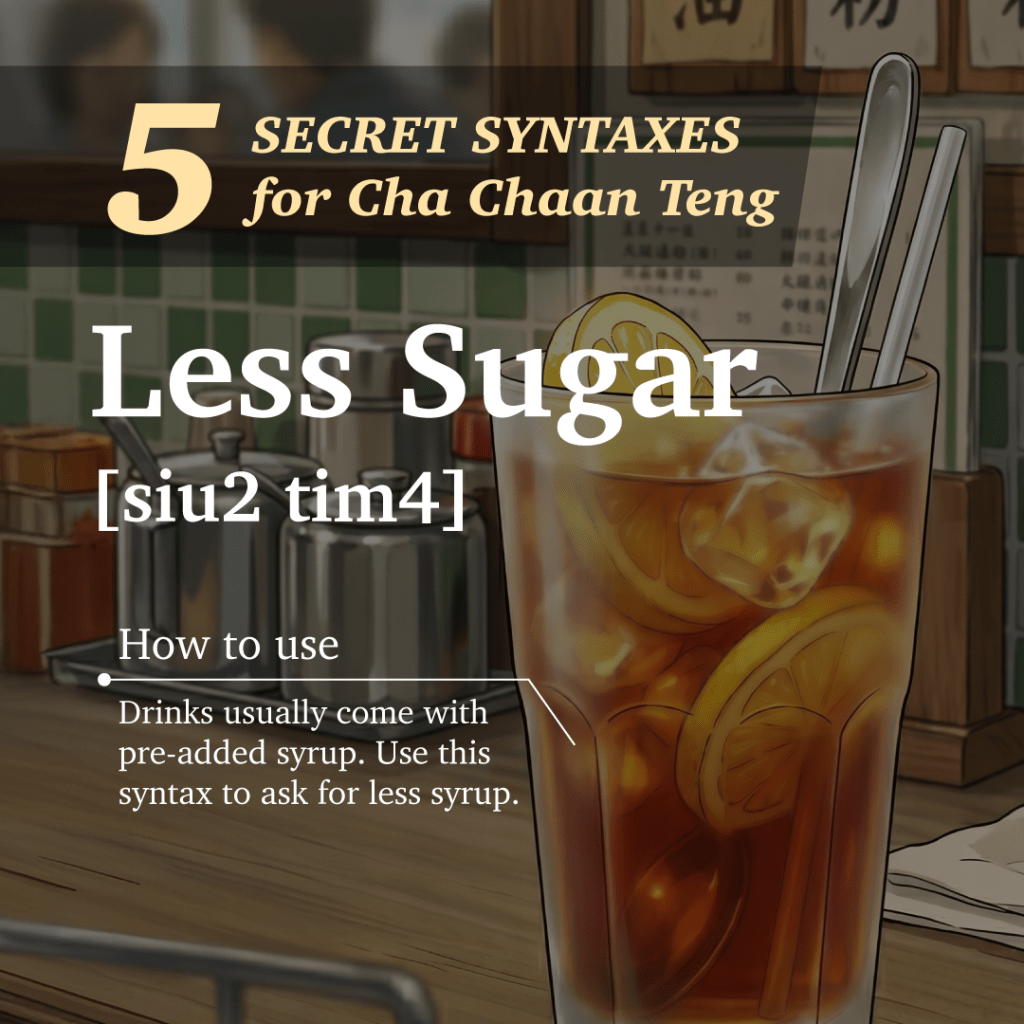
- Less sweet [少甜 – siu2 tim4]: Drinks usually come with pre-added syrup. Use this syntax to ask for less syrup.
2. The Magic of “Zau” (走) – The Condensed Milk Upgrade
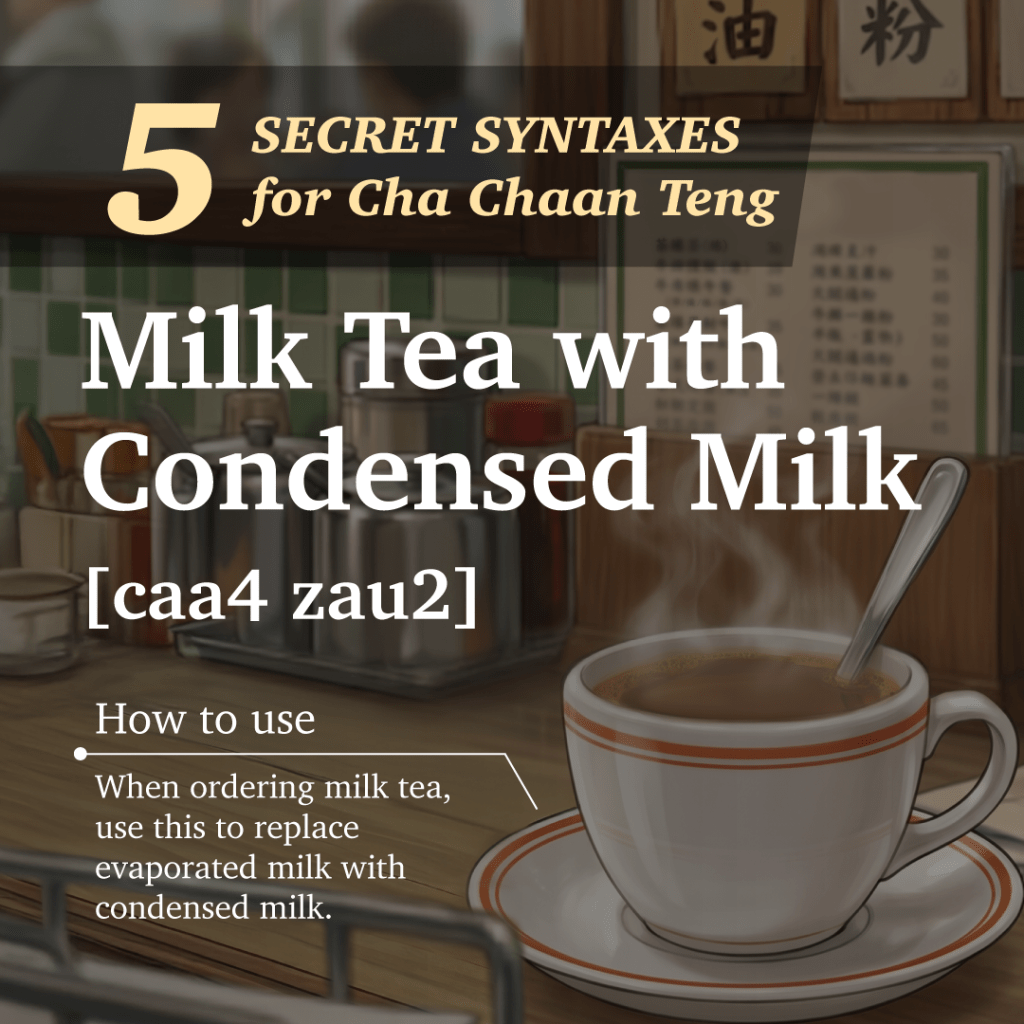
In everyday Cantonese, zau (走) means to “run” or “leave.” However, in the specific context of Cha Chaan Teng hot drinks, it serves as a secret code: replace the standard evaporated milk and sugar with rich, sweet condensed milk. * Milk Tea with Condensed Milk [茶走 – caa4 zau2]: Swaps evaporated milk for condensed milk in your hot milk tea.
- Horlicks with Condensed Milk [立克走 – lap6 hak1 zau2]: Replaces evaporated milk with condensed milk for a richer hot Horlicks.
- Coffee with Condensed Milk [啡走 – fei1 zau2]: Swaps evaporated milk for condensed milk in your hot coffee.
- Yuen Yeung with Condensed Milk [央走 – joeng1 zau2]: Upgrades your coffee-tea mix with condensed milk.
- Ovaltine with Condensed Milk [田走 – tin4 zau2]: Replaces evaporated milk with condensed milk when ordering hot Ovaltine.
3. The Ultimate Insider Code
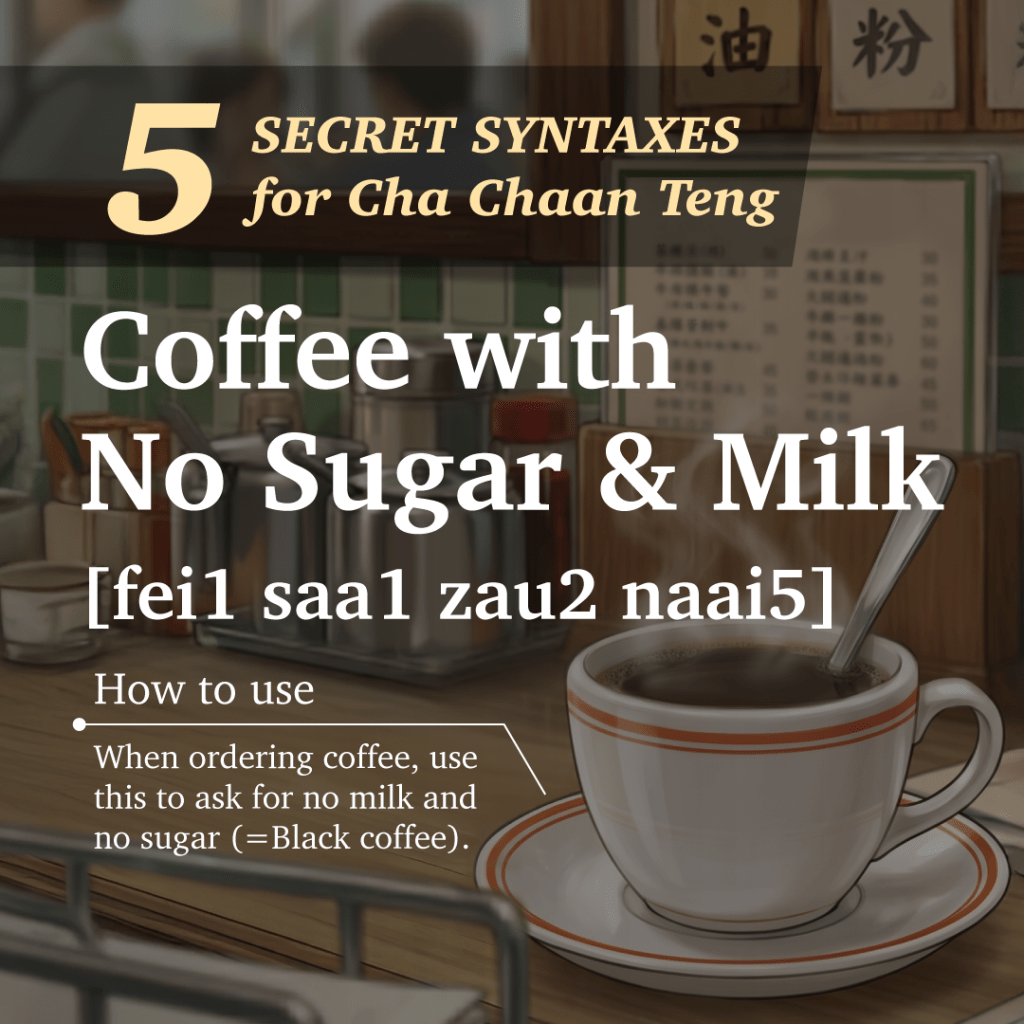
If you want to sound like a true Hong Kong veteran, use this classic, poetic phrase for your morning coffee:
Use case: When ordering coffee, use this to ask for no milk and no sugar. This is how you order a standard black coffee with serious local flair!
Coffee with No Sugar & Milk [飛沙走奶 – fei1 saa1 zau2 naai5]
Literal Translation: “Flying sand, running milk.” (“Sand” refers to sugar crystals; “milk” refers to evaporated milk).
FAQ: Everyday Rituals in Cha Chaan Tengs
Q1: What should I expect on my first Cha Chaan Teng visit in Hong Kong?
Expect a vibrant, fast-paced, and no-nonsense dining environment. Menus are often massive text-heavy sheets slipped under the glass tabletop or slapped onto your desk the moment you sit down. Space is a premium in Hong Kong, so you will almost certainly be seated at a shared table (搭檯 – daap toi) with complete strangers—this is a completely normal part of the culture! The ordering flow is incredibly rapid, so try to decide what you want before catching the waiter’s eye. Above all, don’t stress. Treat your first visit as a fun observation experiment rather than a performance test; just soak in the beautiful, chaotic energy.
Q2: How do I learn the “secret syntax” without feeling awkward?
It is completely normal to feel a bit tongue-tied the first few times you try to order using local slang. The secret is to have your order ready to go before the waiter arrives. To help you master these codes without the stress, you can easily organize your favorite orders digitally. Download my complete Cha Chaan Teng cheat sheet and Notion template here: https://lifeleverage33.gumroad.com/l/mnuhp. Keep it handy on your phone, and you’ll be ordering like a local in no time!
Q3: What are some classic Cha Chaan Teng drinks or dishes to try?
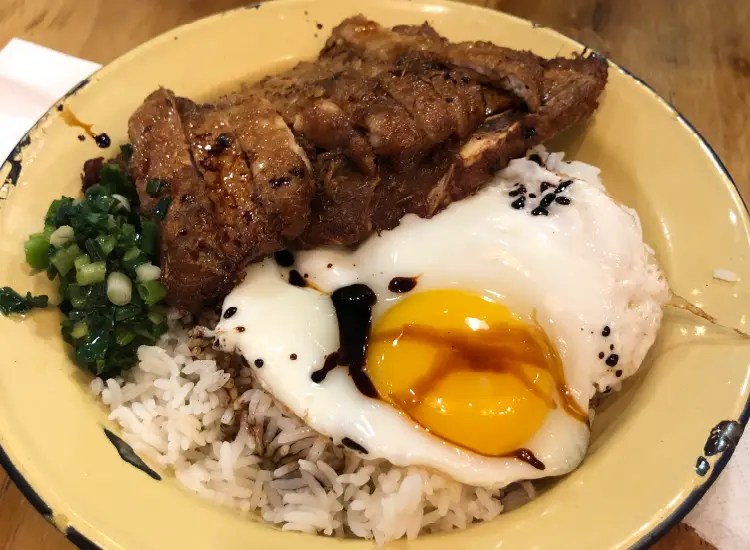
If the massive menu leaves you feeling overwhelmed, you can never go wrong with the historic staples. Start with a classic Hong Kong-style Milk Tea, a warm Pineapple Bun with a thick slab of butter, a comforting bowl of Macaroni Soup with Ham, or a hearty plate of Baked Pork Chop Rice. And remember, the Hong Kong diaspora has spread this incredible food culture globally. Try adapting this list and seeking out these classic dishes at the authentic Cha Chaan Teng spots right in [Add your city name here]!
Q4: How can I bring Cha Chaan Teng rituals into my everyday life?
The beauty of the Cha Chaan Teng is found in its daily rhythms, and you don’t need to be in Hong Kong to appreciate that mindset. You can embrace this by simply taking the time to observe the unique café rituals and unwritten rules in any city you visit. Try naming your own small, comforting rituals at home or work—like the specific, precise way you prepare your morning coffee. You can even keep a short field notebook to jot down interesting local slang, everyday orders, and the unique interactions you observe in your own neighborhood cafes.
Embrace the Chaos
Visiting a Cha Chaan Teng is an essential rite of passage for anyone new to Hong Kong. Do not let the fast pace intimidate you. Sit down, decide quickly, speak up, and try ordering a caa zau to go with your bo lo jau. You will be experiencing the authentic heartbeat of Hong Kong dining culture.
 33 Lab
Leave a comment