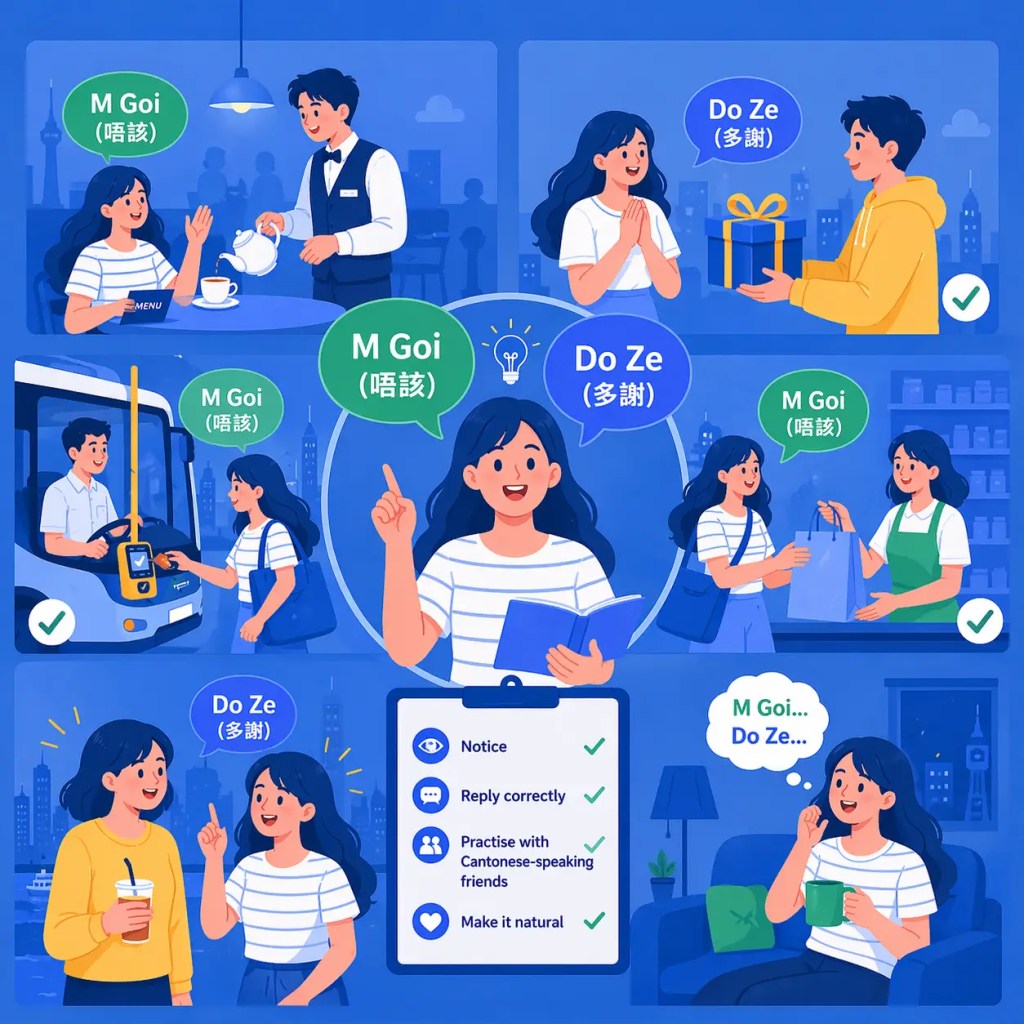
M Goi vs Do Ze: Cantonese Thank You Phrases in Hong Kong

If you have ever been confused about M Goi vs Do Ze in Cantonese, you are not alone. Many English-speaking learners struggle to know which Cantonese thank you phrase is correct in different situations. This guide focuses clearly on when to use
唔該 (M Goi) and when to use
多謝 (Do Ze), explaining their differences with real Hong Kong examples, common mistakes, and an easy reference so you can sound natural, polite, and confident every time you say thank you in Cantonese.
If you are planning a trip to Hong Kong or learning Cantonese seriously, understanding when to use M Goi vs Do Ze will instantly make your Cantonese sound more local and respectful. By the end of this article, you will know exactly when to use M Goi (唔該) for services and small favours, and when to use Do Ze (多謝) for gifts and bigger help, so you can choose the right Cantonese thank you phrase with waiters, friends, your boss, or your in-laws.
What Does “M Goi” (唔該) Mean in Cantonese?
(M Goi) is one of the first Cantonese phrases most learners encounter. It is often translated as thank you, but that is only part of the story. To understand when to use M Goi, it helps to break down its main meanings and typical situations.
In everyday Hong Kong Cantonese, “M Goi” (唔該) is used for:
- Thank you for a service or small favor
- Excuse me / please when getting someone’s attention
- Polite acknowledgement when something minor is done for you
You can think of “M Goi” (唔該) as closer to “thanks” + “please” + “excuse me” in English, depending on the situation.
Common situations: when to use “M Goi” (唔該)
Here are typical real-life examples where when to use M Goi is the right choice:
- When the staff bring you the menu, your drink, or your bill.
- When calling a waiter
- When you want to squeeze past someone on a bus or MTR train.
- When someone moves slightly for you
- When someone passes you an item
Notice that all these are services, actions, or small favors, not big emotional moments or generous gifts.
When not to use “M Goi” (唔該)
- If someone gives you a birthday present, a wedding gift, or a big red packet, do not only say “M Goi” (唔該). In those situations, Hong Kong people expect “Do Ze” (多謝) instead – we will cover this in detail below.
What Does “Do Ze“ (多謝) Mean in Cantonese?
Literally, “Do Ze“ (多謝) means something like “many thanks.
“Do Ze“ (多謝) is the other main way to say Cantonese thank you. It carries a deeper, more formal gratitude than “M Goi” (唔該) and is usually used for gifts, money, and bigger favors.
Common situations: when to use “Do Ze“ (多謝)
- When you receive a gift or red packet
- When someone does a big favor for you
- When people give you congratulations or support on special occasions (wedding, graduation, promotion)
- You receive a discount, free upgrade, or special treatment that goes beyond normal service
M Goi vs Do Ze: When to Use Each in Real Hong Kong Life
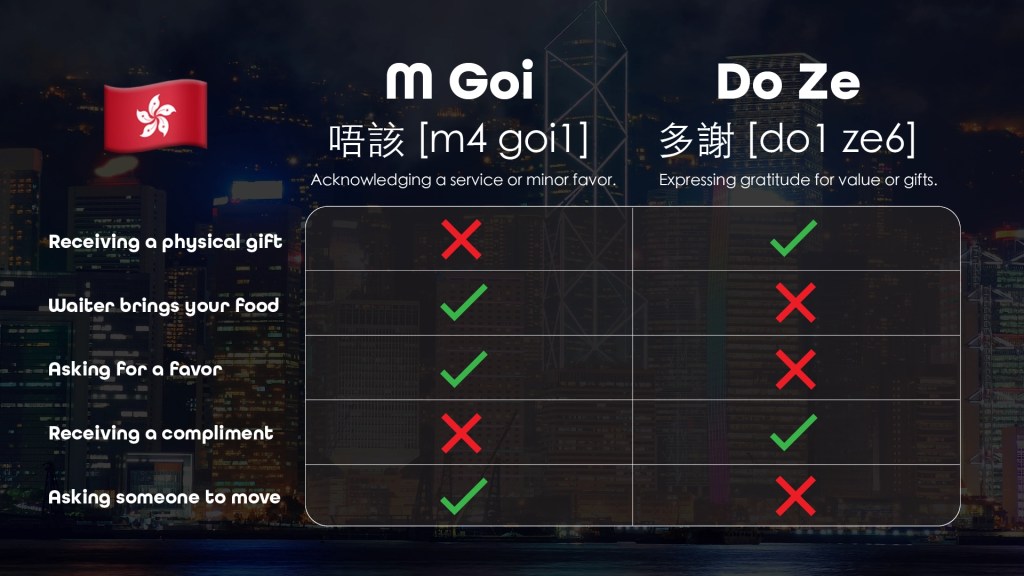
Now let’s put “M Goi” (唔該) vs “Do Ze“ (多謝) side by side. If you remember the difference in service vs gift / big favor, you will already avoid 90% of mistakes.
Simple rule of thumb: M Goi vs Do Ze
- If someone does something for you (a service, small favor) → say
“M Goi” (唔該) - If someone gives something to you (gift, money, big help) → say
“Do Ze“ (多謝)
Side-by-side: when to use “M Goi” (唔該) and “Do Ze“ (多謝)
Use “M Goi” (唔該) when:
- A waiter brings your food or drink.
- A cashier hands back your change.
- Someone passes you an item (napkin, phone, pen).
- You squeeze past people and say “excuse me”.
- You call staff: “Excuse me” to order or pay.
- You receive a very small favor, like someone holding the door.
Use “Do Ze“ (多謝) when:
- You receive a present or souvenir.
- Someone treats you to a meal or coffee.
- You get a red packet at Lunar New Year or a wedding.
- Someone gives you a special discount or extra gift with purchase.
- You receive emotional support during a difficult time.
Common Mistakes Non-Cantonese Speakers Make with Cantonese Thank You Phrases
Even advanced learners mix up “M Goi” (唔該) vs “Do Ze“ (多謝) . Here are some frequent mistakes, with examples of more natural alternatives.
Mistake 1: Using “M Goi” (唔該) for gifts and money
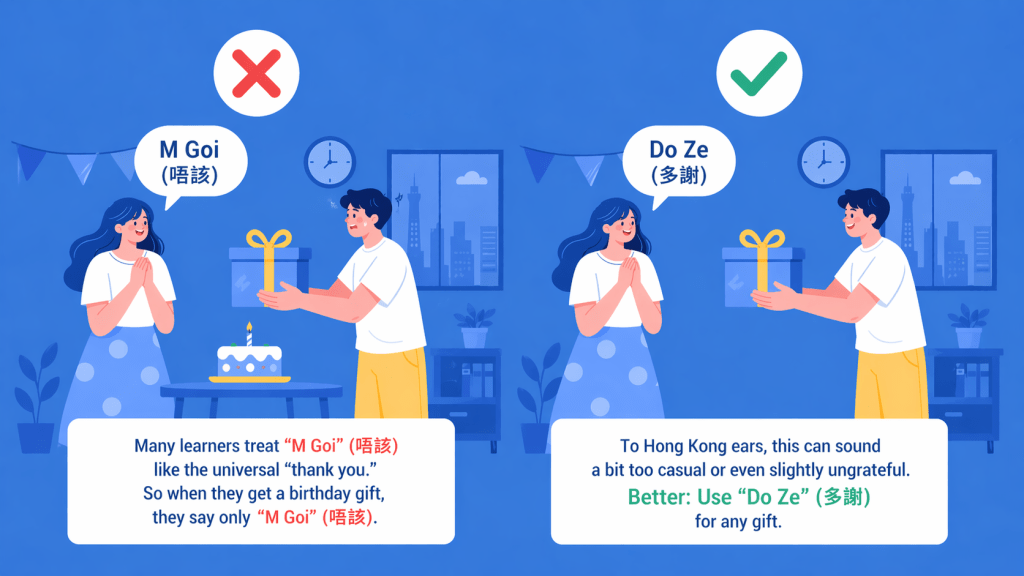
Many learners treat “M Goi” (唔該) like the universal “thank you.” So when they get a birthday gift, they say only “M Goi” (唔該). To Hong Kong ears, this can sound a bit too casual or even slightly ungrateful.
Better: Use “Do Ze“ (多謝) for any gift.
Mistake 2: Using “Do Ze“ (多謝) for small, routine service
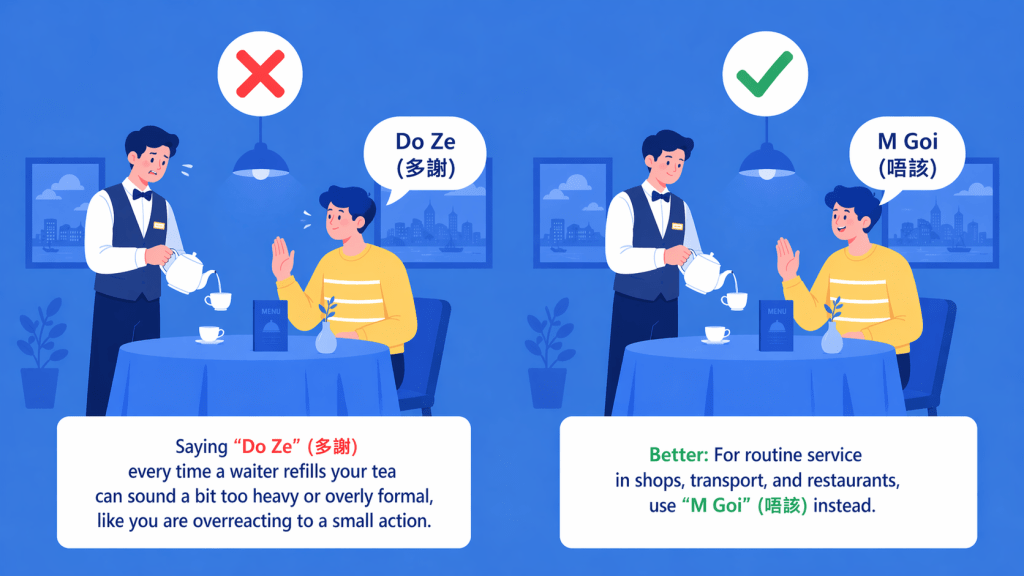
Saying “Do Ze“ (多謝) every time a waiter refills your tea can sound a bit too heavy or overly formal, like you are overreacting to a small action.
Better: For routine service in shops, transport, and restaurants, use “M Goi” (唔該) instead.
How to reply when someone thanks you in Cantonese?
- 唔使客氣 (m4 sai2 haak3 hei3)
Meaning: “No need to be polite,” similar to “You’re welcome” or “Don’t mention it.”
- 小事啫 (siu2 si6 ze1)
Meaning: “It’s just a small thing,” very casual and friendly.
Example mini-dialogue:
A:多謝你送我返屋企。
A: do1 ze6 nei5 sung3 ngo5 faan1 uk1 kei2.
“Thank you so much for giving me a ride home.”
B:唔使客氣,順路啫。
B: m4 sai2 haak3 hei3, seon6 lou6 ze1.
“You’re welcome, it was on the way.”
Quick Cheat Sheet: M Goi vs Do Ze at a Glance
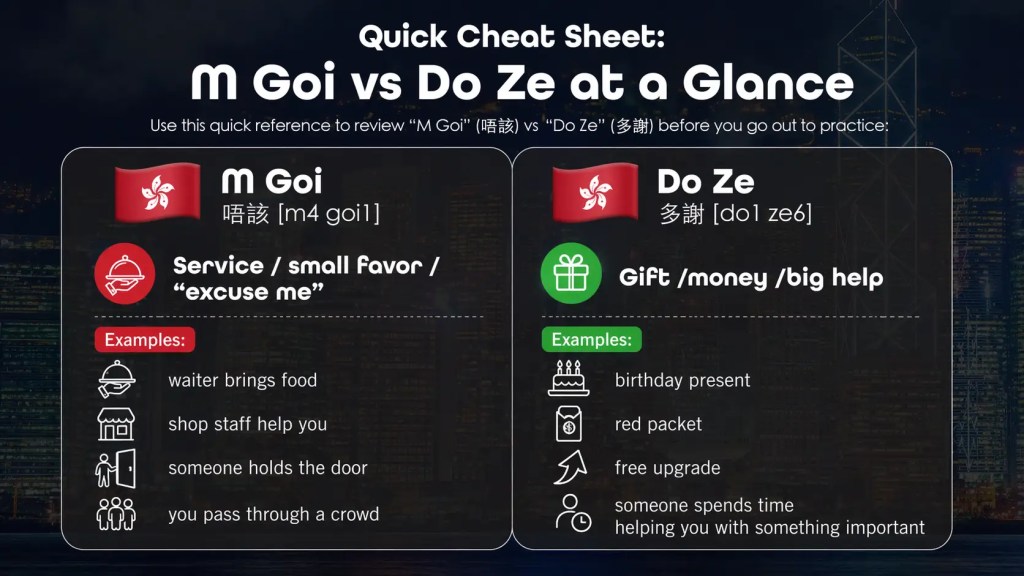
Use this quick reference to review “M Goi” (唔該) vs “Do Ze“ (多謝) before you go out to practice:
- Service / small favor / “excuse me” → “M Goi” (唔該)
Examples: waiter brings food, shop staff help you, someone holds the door, you pass through a crowd. - Gift /money /big help → “Do Ze“ (多謝)
Examples: birthday present, red packet, free upgrade, someone spends time helping you with something important.
Start Using “M Goi” (唔該) and “Do Ze“ (多謝) in Your Daily Life

Now you know the difference between
“M Goi” (唔該) and “Do Ze“ (多謝), including when to use “M Goi” (唔該), when to use
“Do Ze“ (多謝), and how these key Cantonese thank you phrases fit into real Hong Kong etiquette.
If you are planning a trip to Hong Kong, try setting yourself a challenge: on your next day out, consciously notice every time someone does something for you or gives you something, and reply with the correct phrase. Practise with Cantonese-speaking friends, or even say the phrases out loud to yourself at home until they feel natural.
The more you use M Goi vs Do Ze in real conversations, the faster they will become automatic and the more local, polite, and confident you will sound.
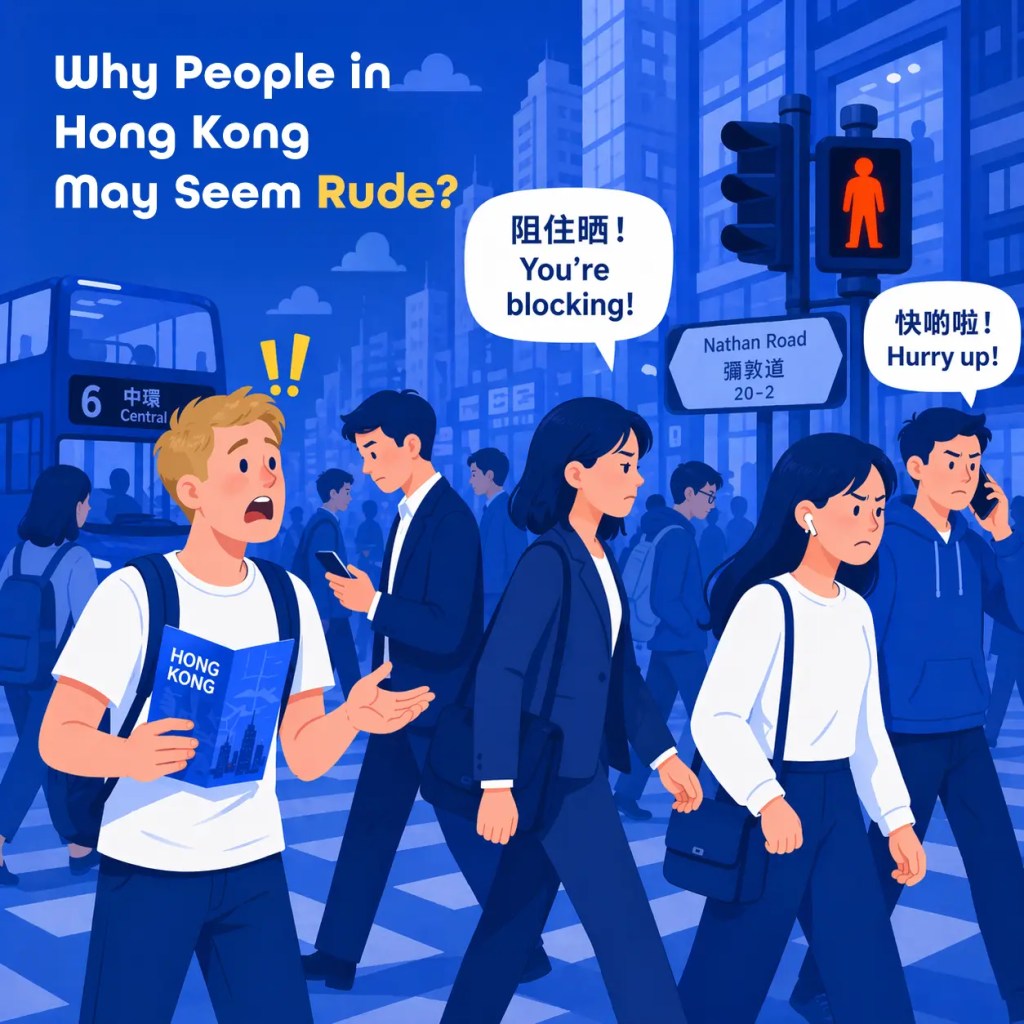


Hong Kong Etiquette FAQ: When to Use ‘M Goi’ vs ‘Do Ze?
Is “M Goi” (唔該) or “Do Ze“ (多謝) more polite?
They are polite in different situations. M Goi is the polite choice for small services and as “excuse me,” while Do Ze is polite and appropriate for gifts and big favors. Native speakers will not think one is “more polite” overall; they will notice whether you use the right one for the context.
Can I say “M Goi” (唔該) for a gift?
Technically people will still understand, but for natural Cantonese you should use “Do Ze“ (多謝) when you receive a gift, money, or a big favor.
How do you say “thank you very much” in Cantonese?
To say “thank you very much” in Cantonese, simply add the intensifier saai3 (晒) to create M Goi Saai3 (唔該晒) for services or Do Ze Saai3 (多謝晒) for gifts. This simple addition helps you sound more sincere and fluent by expressing a “complete” sense of gratitude to native speakers.
If I am not sure, should I say “M Goi” (唔該) or “Do Ze“ (多謝)?
Ask yourself a quick question: Did they do something for me, or give something to me? If it was a service or a tiny favor, “M Goi” (唔該) is usually safe. If they spent money, brought a gift, or helped you in a big way, choose “Do Ze“ (多謝).
Will people in Hong Kong forgive me if I mix them up?
Absolutely. Most Hong Kong people are delighted when visitors attempt any Cantonese at all. If you mix up “M Goi” (唔該) vs “Do Ze“ (多謝), they might smile or gently correct you, but they will still feel your gratitude. Using either phrase is already a sign of respect for Hong Kong etiquette and culture.
How can I master all these unspoken HK social codes without getting overwhelmed?
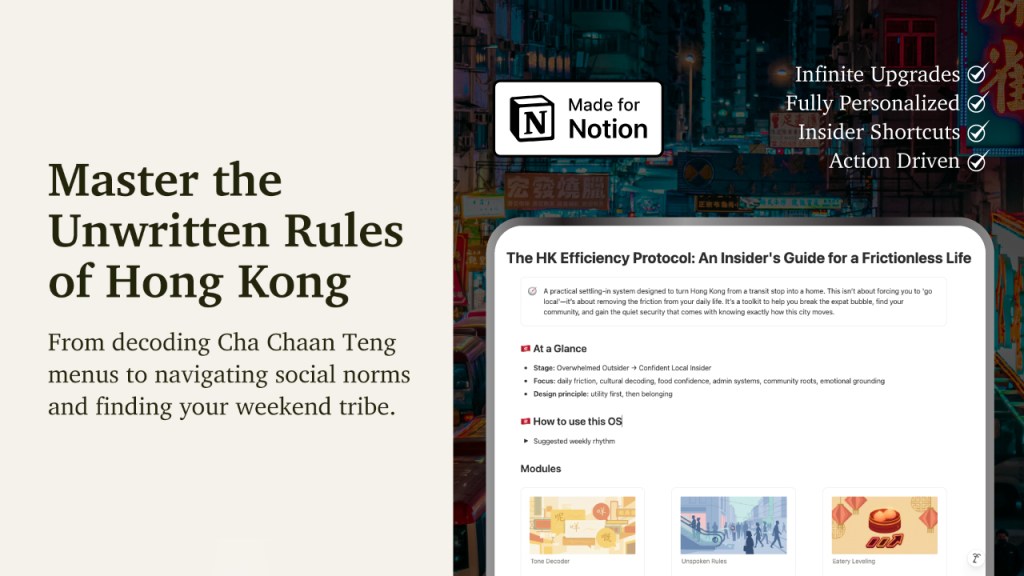
Instead of memorizing a textbook, you just need a reliable system. If you want to bypass the “foreigner wall” and navigate daily interactions with zero friction, I built The HK Efficiency Protocol. It is a comprehensive Notion OS featuring native audio guides, Cha Chaan Teng ordering formulas, and cultural trackers designed to save you 100+ hours of trial and error. Unlock the full system here: https://lifeleverage33.gumroad.com/l/mnuhp
 33 Lab
Leave a reply to Why People in Hong Kong May Seem Rude: A Local Perspective for Non‑Cantonese Speakers – 33 Lab Cancel reply