Rainstorm Warning HK: The Complete Survival Guide to Extreme Weather

A Rainstorm Warning HK is a critical alert issued by the Hong Kong Observatory to notify the public of potentially catastrophic rainfall. The system consists of three distinct levels: Amber, Red, and Black. Navigating these warnings safely requires understanding not only the official guidelines but also the geographical realities of living in different parts of the city—from the sheltered walkways of Central to the flood-prone areas of the New Territories.
Decoding the Signals: What is Amber Rain, Red Rain, and Black Rain?
To survive Hong Kong’s unpredictable wet season, you must understand the three-tier warning system:
Amber Rainstorm Warning Signal
Amber rain HK indicates that heavy rain has fallen or is expected to fall generally over Hong Kong, exceeding 30 millimetres in an hour, and is likely to continue. Many ask, “What is Amber Rain?” Essentially, it acts as an early alert for potential localized flooding.

Points to Note:
- Members of the public should take necessary precautions to reduce risks associated with heavy rain, such as flooding. People should stay away from watercourses that might flood.
- Parents, students, school authorities, and school bus drivers should listen to radio or television announcements on the latest weather, road, and traffic conditions.
- Candidates for public examinations should attend exams as normal but must monitor radio or television broadcasts in case weather conditions suddenly deteriorate.
- Farmers and fish pond operators, particularly those in low-lying or flood-prone areas, should take precautions. This includes checking and clearing drainage systems in and around fields or fish ponds to ensure channels are unblocked and minimize damage. If possible, fish pond operators should lower the water level of ponds that might flood.
Red Rainstorm Warning Signal
Red rain HK indicates that heavy rain has fallen or is expected to fall generally over Hong Kong, exceeding 50 millimetres in an hour, and is likely to continue.

Points to Note:
- People working outdoors in exposed areas should suspend their work until weather conditions permit.
- If you must go out, carefully consider whether the weather and road conditions permit.
- If the Red signal is issued before working hours and public transport services are operating normally, employees should report for duty as usual. If employees experience genuine difficulties in reporting for work on time, supervisors should adopt a flexible approach.
- If the Red signal is issued during working hours, indoor workers should remain on duty unless the workplace poses a danger. If transport services in the area where employees work are about to be suspended, supervisors may consider allowing staff to leave early based on actual circumstances, considering weather and road conditions.
Black Rainstorm Warning Signal
Black rain HK is the most severe level, indicating that heavy rain has fallen or is expected to fall generally over Hong Kong, exceeding 70 millimetres in an hour, and is likely to continue.

Points to Note:
- Members of the public should stay indoors and take shelter in a safe place until the heavy rain has passed.
- People working outdoors in exposed areas should stop work and take shelter in a safe place immediately.
- If you cannot find a safe place, you can seek shelter in temporary shelters operated by the Home Affairs Department.
- The government urges employers not to require employees to go to work unless prior agreement on work arrangements during rainstorms has been made.
- If employees are already at work, they should remain at their current workplace unless it poses a danger.
Special Notes for Red / Black Rainstorm Warning Signals
- Student Safety: Students who have not yet left for school should stay home. Students who have already arrived at school should remain in school until conditions are safe for them to return home.
- Commuting Students: If the Red/Black signal is issued while students are on their way to school, and they learn of class suspensions while commuting, they should decide whether to continue their journey to school based on the rain, road, slope, or traffic conditions. School bus drivers should tune in to radio updates and, unless road or traffic conditions do not permit, ensure students are taken to a safe place (usually the school they attend).
- School Operations: Schools must keep their premises open until normal dismissal time and implement contingency measures, including arranging staff to supervise students who have arrived at school.
- Public Exams: Candidates for public exams should listen to radio or television broadcasts for announcements from the Hong Kong Examinations and Assessment Authority regarding that day’s exams.
- Traffic & Flooding Risks: Drivers should beware that there may be serious flooding and traffic congestion on the roads. Members of the public should stay away from flood-prone watercourses and avoid crossing flooded areas. If your residence is prone to serious flooding, consider evacuating until the heavy rain subsides and the floodwaters recede.

For more detailed and official guidelines, please refer to the following external resources:
- Code of Practice in Times of Adverse Weather and “Extreme Conditions” (Labour Department)
- What do rainstorm warning signals mean to you? (Education Bureau)
A Tale of Two Cities: Central Shelters vs. Kowloon and New Territories Vulnerability
The reality of a Rainstorm Warning HK varies wildly depending on geographical location. On one hand, individuals residing in the Mid-Levels or commercial hubs like Central often view severe rain as a “minor inconvenience.” They share stories of navigating completely indoor environments, moving seamlessly through air-conditioned corridors and underground passages (like the IFC mall connecting to Hong Kong Station) to shop and dine. Some even joke that a black rainstorm just gives them an excuse to buy a new pair of Crocs.

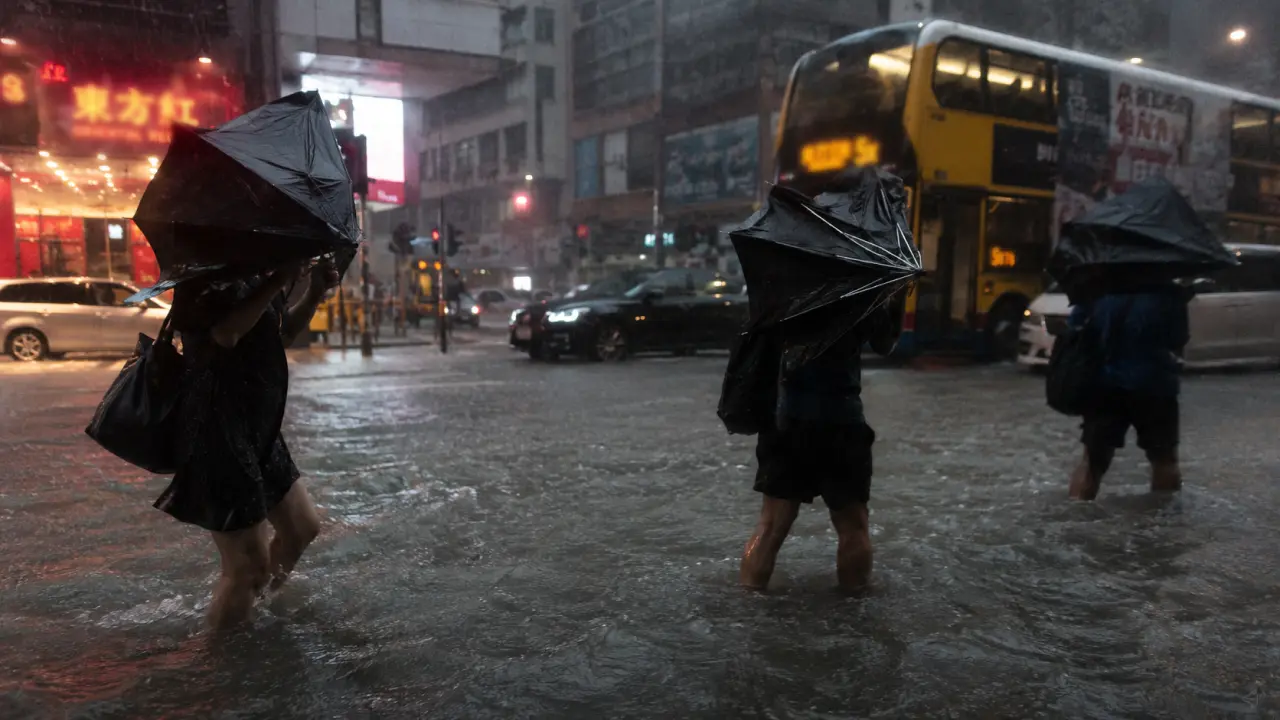
On the other hand, residents in the New Territories and parts of Kowloon face genuine survival threats. Social media forums frequently surface shocking footage of infrastructure failures during extreme weather: Wong Tai Sin MTR station and its adjacent mall bottom floors completely swallowed by floodwaters, Austin Station turning into an indoor waterfall, and South Horizons MTR station experiencing burst pipes that flood the platforms, forcing passengers to wait anxiously in cramped service elevators for evacuation. In the New Territories, users have witnessed flash floods submerging entire villages in an instant, forcing the elderly to flee, while hundreds of vehicles in LOHAS Park’s open-air car parks are completely submerged.
Beyond the Rain: Thunderstorms, Landslips, and NT Flooding
A Rainstorm Warning HK rarely comes alone. Extreme weather brings additional hazards that every resident must monitor:

- HK thunderstorm warning: Often accompanying heavy rain, a HK thunderstorm warning means lightning and intense gusts are imminent. If you see alerts for squally thunderstorms HK, secure outdoor loose objects immediately.
- Landslide warning HK (HK landslip): Due to Hong Kong’s mountainous terrain, heavy, continuous rain greatly increases the risk of landslides. The HK landslip warning tells residents near steep slopes or retaining walls to stay vigilant and move to higher, safer ground.
- Special Announcement on Flooding in the Northern NT: The northern areas are particularly vulnerable to a New Territories flood. When the Special Announcement on Flooding in the Northern NT is issued, it warns farmers and villagers of imminent NT flooding, which can wipe out crops and endanger lives within minutes.
- You might also like: Dangerous Hong Kong Typhoon: Exactly What to Do During a T8 Typhoon in HK to Survive
The “2-Hour Rule” Nightmare: Commuter Chaos and Local Wisdom
According to Labour Department guidelines, when a Typhoon Signal No. 8, Black rain HK, or “Extreme Conditions” announcement is cancelled during working hours, employees are generally required to return to their workplaces within two hours, considering safety and traffic conditions. On paper, this is a reasonable buffer. In reality, local knowledge reveals that these two hours are often a logistical nightmare.

The moment the signal is lifted, millions of workers simultaneously rush into the public transport system. MTR stations implement strict crowd control measures, bus stops see queues stretching for hundreds of meters, and roads are typically gridlocked due to storm aftermaths like fallen trees and deep puddles.
The local survival wisdom is simple: either arrive near your office before the signal is officially cancelled (the Observatory usually gives advance notice), or reach an unspoken agreement with your boss to deliberately delay your departure to avoid peak chaos. Many locals even apply to continue working from home for the rest of the day, citing severe flooding in their residential areas. Employees who are unaware of these unwritten rules often strictly follow the two-hour regulation, ending up trapped in a sweltering, dangerous sea of humanity.
Visit our complete Hong Kong summer weather guide:
FAQs about Rainstorm Warning HK

What should I do if a Black rain HK signal is issued while I am at work?
You should remain indoors and take shelter in a safe place until the heavy rain passes and the signal is downgraded. Do not attempt to travel home.
Can I hike during an HK thunderstorm warning?
No. Hiking during an HK thunderstorm warning or when squally thunderstorms HK are forecasted is extremely dangerous and life-threatening. Always check the Hong Kong Observatory before heading to the trails.
How is public transport and traffic affected during a Rainstorm Warning HK?
During Amber and Red rainstorm warnings, public transport generally operates as usual, but you should expect delays due to road conditions and traffic congestion. However, when a Black rain HK signal is hoisted, surface transport like buses and ferries are often severely reduced or completely suspended. The MTR typically maintains a limited service, but stations located in exposed or flooded areas may be forced to close. Always check official announcements from transport operators like KMB, Citybus, and MTR before attempting to travel.
How do rainstorm warnings affect the daily lives of ordinary people in Hong Kong?
For most ordinary residents, the most significant impact of a Rainstorm Warning HK is severe traffic congestion. While it may be pouring outside, remaining indoors is generally safe and problem-free. However, under any weather warning, you should absolutely avoid hiking or going near hillsides. If you live in a village house, detached home, or on the ground floor, you must stay vigilant about potential flooding and proactively move your belongings to a higher place early on.
How can I master all these unspoken HK social codes without getting overwhelmed?

Instead of memorizing a textbook, you just need a reliable system. If you want to bypass the “foreigner wall” and navigate daily interactions with zero friction, I built The HK Efficiency Protocol. It is a comprehensive Notion OS featuring native audio guides, Cha Chaan Teng ordering formulas, and cultural trackers designed to save you 100+ hours of trial and error. Unlock the full system here: https://lifeleverage33.gumroad.com/l/mnuhp
About the Author / Local Insight
Hi, I’m the creator behind 33 Lab! As a Hong Kong local, I know firsthand that this fast-paced city can feel intimidating to newcomers. I created 33 Lab because I saw too many expats mistaking our high-energy, direct communication style for unfriendliness.
My mission is to help you skip the culture shock, decode the local lifestyle, and discover the genuine warmth of the Hong Kong people. Visit 33-lab.com for more cultural guides and tips on navigating the city like a true local!
More Hong Kong Survival Guides
Browse the complete Hong Kong Survival Guide collection!


Leave a Reply